


















Test report by CoMod Mike on Carrera DIGITAL 124
the Audi R10 TDI (23716) Test environment:
Club track (wood)
27 m track length; 16/18 volt
track voltageNon-magnetic wires. Therefore, no magnetic effect.
Wooden track: Places high demands on roundness and chassis geometry
. Car setup: OOTB (with both magnets)
. Additional tire sanding after the OOTB test.
Appearance:
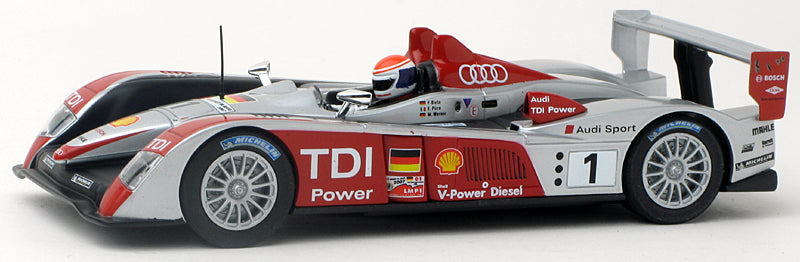
The Audi team isn’t exactly known for its variety. The silver-red or silver-yellow Le Mans prototypes are, after all, a familiar sight on the 24-hour track and on our local racetracks as well. However, the matte black stripes nicely highlight the contours of the Audi race car and break up the boxy design a bit.Carrera
Of course, compromises have to be made to fit the technology into the severely restricted cross-section... But that’s only noticeable in a direct comparison. Otherwise, it’s a very nicely executed model.
Some details are beautifully crafted… for example, various indicator lights on the steering wheel are color-coded. One thing that might slightly detract from the model’s accuracy right out of the box is the high-mounted front axle, but this can be easily fixed with a highly recommended modification (see below).
Technical Specs:
Body: 50 g; Total Weight: 230 g. In terms of construction, the vehicle features the usual high-quality build. Screws and threaded connections allow for easy and precise disassembly of the individual components, though this does come at the expense of weight. However, this does not adversely affect the vehicle’s handling.
Workmanship:
The rims run smoothly, and only the unfinished tires showed a slight wobble—which is normal for cast tires andCarrera
less of an issue on the
track.
Inside the car, there’s nothing to complain about… the usual clean workmanship from the Exclusiv Generation. The printing is very cleanly executed; however, the matte black stripes—some of which were difficult to access—had to be applied in certain areas using a paint stencil… resulting in a slightly “blurred” edge.
Handling:
I started with 16 volts out-of-the-box in analog mode and already had a quite pleasant ride on the wooden track with only slight stuttering in the curves. Surprisingly, even with the high guide keel setting and axle position, the car was barely pushed out of the curve. Without any further adjustments, I was able to achieve very consistent lap times of 8.8 seconds.
As I already mentioned under “Appearance,” the car looks a bit high-riding at the front axle! That’s why the first thing I do on the Exclusiv or D124 models is…. is to remove the leaf spring from the front axle. This is actually a must for a track without overpasses or steep inclines. With a slight adjustment to the control arm screw, the car can now sit lower in the slot and exhibits significantly more stable cornering behavior.
Grinding the rear tires subsequently resulted in a much smoother ride. Lap times improved to 8.5 seconds, which shows that the handling was already quite good before the grinding!
When switching to 18 V, the car was significantly more fun to drive on the large wooden track. Speed and acceleration are now perfectly balanced, and thanks to the tire modifications, even cornering is a pleasure—the chassis’s weight helps facilitate smoother drifting. Furthermore, you could easily vary the setup here using the alternative gear ratios from the accessories line, depending on the track.
Conclusion:
The design of the endurance prototypes proves to be optimal not only at Le Mans. These cars also demonstrate their strength on the racetrack! Unfortunately, the variety of colors isn’t as exciting as with the GT cars, which is why I’d like to see even more color options from the manufacturers! In any case, the potential to be a club car on large tracks is definitely there, and the R10 also shows its edge on the home track...
CoMod Mike
the Audi R10 TDI (23716) Test environment:
Club track (wood)
27 m track length; 16/18 volt
track voltageNon-magnetic wires. Therefore, no magnetic effect.
Wooden track: Places high demands on roundness and chassis geometry
. Car setup: OOTB (with both magnets)
. Additional tire sanding after the OOTB test.
Appearance:
The Audi team isn’t exactly known for its variety. The silver-red or silver-yellow Le Mans prototypes are, after all, a familiar sight on the 24-hour track and on our local racetracks as well. However, the matte black stripes nicely highlight the contours of the Audi race car and break up the boxy design a bit.
Some details are beautifully crafted… for example, various indicator lights on the steering wheel are color-coded. One thing that might slightly detract from the model’s accuracy right out of the box is the high-mounted front axle, but this can be easily fixed with a highly recommended modification (see below).
Technical Specs:
Body: 50 g; Total Weight: 230 g. In terms of construction, the vehicle features the usual high-quality build. Screws and threaded connections allow for easy and precise disassembly of the individual components, though this does come at the expense of weight. However, this does not adversely affect the vehicle’s handling.
Workmanship:
The rims run smoothly, and only the unfinished tires showed a slight wobble—which is normal for cast tires and
Inside the car, there’s nothing to complain about… the usual clean workmanship from the Exclusiv Generation. The printing is very cleanly executed; however, the matte black stripes—some of which were difficult to access—had to be applied in certain areas using a paint stencil… resulting in a slightly “blurred” edge.
Handling:
I started with 16 volts out-of-the-box in analog mode and already had a quite pleasant ride on the wooden track with only slight stuttering in the curves. Surprisingly, even with the high guide keel setting and axle position, the car was barely pushed out of the curve. Without any further adjustments, I was able to achieve very consistent lap times of 8.8 seconds.
As I already mentioned under “Appearance,” the car looks a bit high-riding at the front axle! That’s why the first thing I do on the Exclusiv or D124 models is…. is to remove the leaf spring from the front axle. This is actually a must for a track without overpasses or steep inclines. With a slight adjustment to the control arm screw, the car can now sit lower in the slot and exhibits significantly more stable cornering behavior.
Grinding the rear tires subsequently resulted in a much smoother ride. Lap times improved to 8.5 seconds, which shows that the handling was already quite good before the grinding!
When switching to 18 V, the car was significantly more fun to drive on the large wooden track. Speed and acceleration are now perfectly balanced, and thanks to the tire modifications, even cornering is a pleasure—the chassis’s weight helps facilitate smoother drifting. Furthermore, you could easily vary the setup here using the alternative gear ratios from the accessories line, depending on the track.
Conclusion:
The design of the endurance prototypes proves to be optimal not only at Le Mans. These cars also demonstrate their strength on the racetrack! Unfortunately, the variety of colors isn’t as exciting as with the GT cars, which is why I’d like to see even more color options from the manufacturers! In any case, the potential to be a club car on large tracks is definitely there, and the R10 also shows its edge on the home track...
CoMod Mike