













Test report by CoMod joergW on Carrera the Evo/D132 Audi R8 LMS Team Abt Sportsline 24 Hours of Nürburgring 2009 "No.100" " and the Audi R8 LMS Team Phoenix 24 Hours of Nürburgring 2009 "No.98"
(27321/27322 and 30514/30515)
The Audi R8 LMS was built by quattro GmbH in collaboration with Abt Sportsline in accordance with the Group GT3 regulations, adding yet another member of the large VW family to the starting grid alongside the well-known Porsches and the relatively new Scirocco.
Since the summer of 2009, a total of 12 vehicles have beenGo
fielded by various racing teams in European GT competitions and in the BF
Odrich Endurance Championship. At the 24-hour race at the Nürburgring, two teams each fielded two Audi R8 LMS cars, and one car finished the race in second place overall, behind a Porsche 997 GT3 RSR from the Manthey Team. A great start!
Power comes from a 5.2-liter naturally aspirated V10 engine mounted in front of the rear axle. The direct-injection engine produces 500 PS (370 kW) and delivers a maximum torque of 500 Newtonmeters. Power is transmitted to the rear axle via a 6-speed sport transmission with paddle shifters. The all-wheel-drive system installed as standard in the R8 was replaced by rear-wheel drive due to regulation requirements. The suspension uses almost exclusively production-spec components. Extensive safety features also provide the highest level of passive safety.
In the fall of 2009, sales to motorsport teams began. (Net price:€ 262.000 ) Add to that a few euros for race livery, aftermarket parts, the right tires, etc. Getting started with a 1:32 scaleCarrera
model is definitely a much more affordable option.
Appearance:
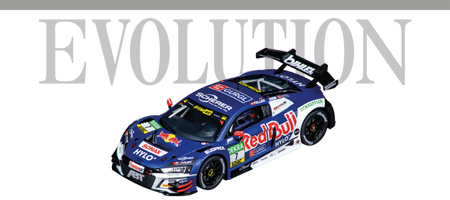
Both vehicles, now available as Evo models, feature a truly fantastic, highly detailed
overall look. When comparing the wheels to images found online, they fit well within the wheel wells and are largely true to the prototype. We’ll see—maybe I’ll get to see a real one this year. Black-silver and blue-yellow—colors that are easily recognizable on the racetrack—can also be used in a variety of racing series in the 1:32 scale.
Technical Details:
The solid front axle has a bit more lateral play, but this can be easily corrected using clip-on plastic rings. Personally, it didn’t bother me while driving. Due to the absence of lights, the uncluttered top surface of the chassis offers plenty of space for targeted lead tuning. The front keel section, positioned very far forward, features the new, significantly increased swivel range.
Workmanship:
The paint job and printing are good. Only in the challenging area of the light blue line that runs all the way around—separating the blue from the yellow section—is a minor flaw noticeable. The lettering and advertising decals are all very legible.
The front axle turns easily; the rims and axles pose no problems. The tires sit firmly enough—even without adhesive—to allow for very fast driving with a magnet. The tires’ grip is okay.
Handling:
As expected, handling is very smooth, since the width-to-length ratio and other suspension geometry factors work very well for the vehicle, which is confirmed on the track.
Conclusion:
I don't think I need to be a fortune-teller to predict that there will be more versions of this model (especially since the 24-hour version isn't included yet)!
CoMod JoergW
(27321/27322 and 30514/30515)
The Audi R8 LMS was built by quattro GmbH in collaboration with Abt Sportsline in accordance with the Group GT3 regulations, adding yet another member of the large VW family to the starting grid alongside the well-known Porsches and the relatively new Scirocco.
Since the summer of 2009, a total of 12 vehicles have been
Power comes from a 5.2-liter naturally aspirated V10 engine mounted in front of the rear axle. The direct-injection engine produces 500 PS (370 kW) and delivers a maximum torque of 500 Newtonmeters. Power is transmitted to the rear axle via a 6-speed sport transmission with paddle shifters. The all-wheel-drive system installed as standard in the R8 was replaced by rear-wheel drive due to regulation requirements. The suspension uses almost exclusively production-spec components. Extensive safety features also provide the highest level of passive safety.
In the fall of 2009, sales to motorsport teams began. (Net price:€ 262.000 ) Add to that a few euros for race livery, aftermarket parts, the right tires, etc. Getting started with a 1:32 scale
Appearance:
Both vehicles, now available as Evo models, feature a truly fantastic, highly detailed
overall look. When comparing the wheels to images found online, they fit well within the wheel wells and are largely true to the prototype. We’ll see—maybe I’ll get to see a real one this year. Black-silver and blue-yellow—colors that are easily recognizable on the racetrack—can also be used in a variety of racing series in the 1:32 scale.
Technical Details:
The solid front axle has a bit more lateral play, but this can be easily corrected using clip-on plastic rings. Personally, it didn’t bother me while driving. Due to the absence of lights, the uncluttered top surface of the chassis offers plenty of space for targeted lead tuning. The front keel section, positioned very far forward, features the new, significantly increased swivel range.
Workmanship:
The paint job and printing are good. Only in the challenging area of the light blue line that runs all the way around—separating the blue from the yellow section—is a minor flaw noticeable. The lettering and advertising decals are all very legible.
The front axle turns easily; the rims and axles pose no problems. The tires sit firmly enough—even without adhesive—to allow for very fast driving with a magnet. The tires’ grip is okay.
Handling:
As expected, handling is very smooth, since the width-to-length ratio and other suspension geometry factors work very well for the vehicle, which is confirmed on the track.
Conclusion:
I don't think I need to be a fortune-teller to predict that there will be more versions of this model (especially since the 24-hour version isn't included yet)!
CoMod JoergW