













CoMod Carrera 124 Review of the Carrera DIGITAL 124 '34 Hotrod High Performance Roadster
(23717)
More Than Just a Color Variation…At
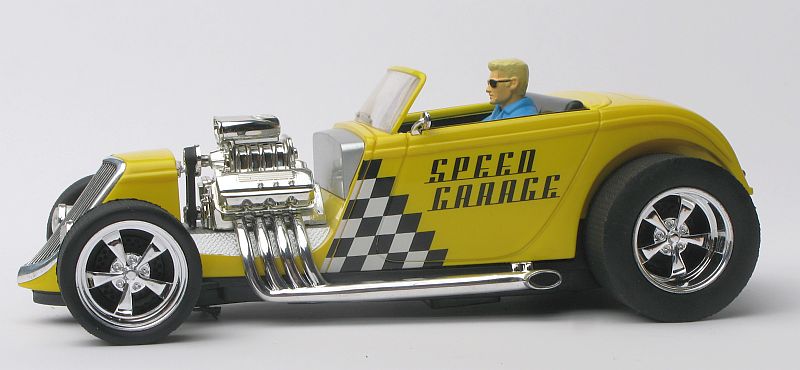
first glance, this vehicle appears to be nothing more than a new color variation. But a second look reveals that the combination of an open hood and an open roof has never before been seen on the ’34 Hot Rod. As is always the case with hot rods, it’s pointless to discuss historical accuracy or scale-accurate reproduction at this point. The yellow paint job certainly catches the eye; the lettering and the subtle flag pattern make the car look fast even when it’s just sitting still. Of all the variants of this type released so far, this one looks by far the most “race-ready.”
Since there are no fenders attached to the body, the vehicle has rear tires with a slightly larger outer diameter, just like the blue ’34 Hot Rod. As a result, these two vehicles have a slightly longer final drive ratio compared to the other three versions of this model. So if you want to bring these racers to a comparable level, you should fit them with the rear tires that have the smaller diameter (Part No. 85270 standard tires or Part No. 83044 tuning tires). As a side effect, you’ll get slightly better performance when accelerating and braking.
Technically, the car offers nothing new—it uses the exact same chassis as the previous analog Hotrods. It’s particularly delicate in the front section. As a result, the swing arm and digital circuit board on all Hotrods are narrower than on the rest of the 1/24-scale cars. Without magnets, the car weighs 210 grams, which is surprisingly a bit heavier than the Ferrari 250 GTO I tested at the same time.
Since the author of this article had already successfully competed in a club race with the ’34 Hot Rods at the club meet back in 2006, expectations were relatively high going into the test drive. All chassis magnets were quickly removed; otherwise, no further modifications were made. The handling turned out exactly as expected: due to the slightly longer final drive ratio, the yellow Hotrod drives and brakes a bit sluggishly, though it remains good-natured at all times. For a track that does them justice, a somewhat more generously sized racetrack is recommended, with larger curve radii and longer straights.
Conclusion: the Hotrods still aren’t quite my thing. This one, however, looks the most like a race car, and certainly has its place in the lineup.
CoModCarrera 124
More Than Just a Color Variation…At
first glance, this vehicle appears to be nothing more than a new color variation. But a second look reveals that the combination of an open hood and an open roof has never before been seen on the ’34 Hot Rod. As is always the case with hot rods, it’s pointless to discuss historical accuracy or scale-accurate reproduction at this point. The yellow paint job certainly catches the eye; the lettering and the subtle flag pattern make the car look fast even when it’s just sitting still. Of all the variants of this type released so far, this one looks by far the most “race-ready.”
Since there are no fenders attached to the body, the vehicle has rear tires with a slightly larger outer diameter, just like the blue ’34 Hot Rod. As a result, these two vehicles have a slightly longer final drive ratio compared to the other three versions of this model. So if you want to bring these racers to a comparable level, you should fit them with the rear tires that have the smaller diameter (Part No. 85270 standard tires or Part No. 83044 tuning tires). As a side effect, you’ll get slightly better performance when accelerating and braking.
Technically, the car offers nothing new—it uses the exact same chassis as the previous analog Hotrods. It’s particularly delicate in the front section. As a result, the swing arm and digital circuit board on all Hotrods are narrower than on the rest of the 1/24-scale cars. Without magnets, the car weighs 210 grams, which is surprisingly a bit heavier than the Ferrari 250 GTO I tested at the same time.
Since the author of this article had already successfully competed in a club race with the ’34 Hot Rods at the club meet back in 2006, expectations were relatively high going into the test drive. All chassis magnets were quickly removed; otherwise, no further modifications were made. The handling turned out exactly as expected: due to the slightly longer final drive ratio, the yellow Hotrod drives and brakes a bit sluggishly, though it remains good-natured at all times. For a track that does them justice, a somewhat more generously sized racetrack is recommended, with larger curve radii and longer straights.
Conclusion: the Hotrods still aren’t quite my thing. This one, however, looks the most like a race car, and certainly has its place in the lineup.
CoMod