

















CoMod Carrera 124 Test Report on the Carrera DIGITAL 124 2009 Porsche 997 GT3 RSR Flying Lizard
(23742)
Technical Specifications:
Weight (complete vehicle with magnets): 215
grams Weight (body): 60 grams
; Length including spoiler: 185
mm; Wheelbase: 99
mm; Track width (front axle): 77
mm; Track width (rear axle): 81
mm; Overview of design and country variants:
Two variants are planned for the 2010 lineup: the red-and-silver version is already shipping, while the blue Felbermayr version will be released after Christmas.
Appearance:
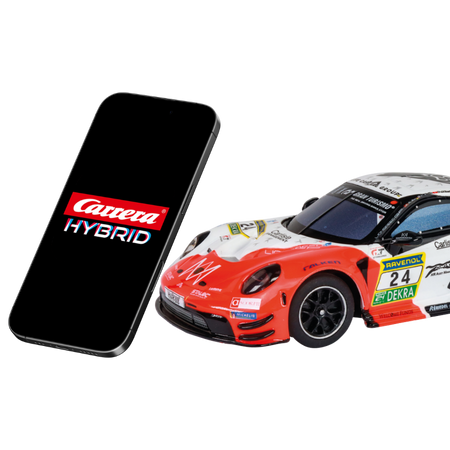
The pictures speak for themselves here. The car looks great from every angle and sits firmly on the track. The rear wheels might sit just a tad lower in the wheel wells, but that’s just nitpicking.
Chassis:
The new generation of chassis from 2010. In principle, the redesign followed a similar approach to that used in the smaller 1:32 scale during the transition from the 2007 to the 2009 chassis generation: retaining what has been proven effective and eliminating the superfluous. The result is a relatively no-frills and noticeably lighter chassis. The changes in detail, from front to rear:—
The swingarm is already familiar from this year’s design variants. It features a significantly larger angle of rotation, which is particularly noticeable in magnet-free operation. A small compression spring gently presses it against the road at all times.
- The front axle is now rigidly mounted; fortunately, the compression spring previously used has been eliminated. The familiar height-adjustment mechanism is still present. So if you really want to navigate tight, steep turns, you can raise the Porsche
.— The center magnets are inserted from the inside, and the corresponding bracket is conveniently bolted to the motor mount. This saves on screws and weight. However, if you remove the center magnets, you’re left with an unsightly rectangular hole in the chassis floor through which lint and dirt can get in (Note: the other new 1:24 scale models have been improved in this regard and feature a completely sealed underbody). The opening can be sealed by mounting the magnet housing upside down. —
The combined engine-gearbox block remains unchanged; however, the large metal threaded plate has been significantly reduced in size to the absolute minimum
. — The rear magnet is attached to the rear axle mount. This, too, is a solution found only in Porsche; the other new design features of the D124 have also been further refined here
. The rims are still two-piece, though they are no longer split down the center—instead, they consist of a base body and an insert.
Test drive (with magnets):
If you leave the magnets installed, the handling is, as expected, “like on rails.” Compared to a Corvette C6R or a Ferrari 575, however, the lower weight is noticeable. The Porsche accelerates much more aggressively; it drives “lighter” in the truest sense of the word.
Test drive (without magnets):
Removing the magnets is a bit more tedious than with the older chassis generation. To get straight to the point, though, it’s worth the effort. The concentricity of the axle and rims is fine; the changes in the production process seem to be paying off. In this state, I headed back out onto my test track. Since it’s on the small side, I also run the 1:24-scale cars with theDIGITAL 132 power supply. And with that, the Porsche really hit its stride. It was just as fast as it was easy to handle. Even when entering corners way too fast, it didn’t end in a crash but just a harmless spin. There was no noticeable tendency to tip over, and the motor works well with the car’s weight: pure driving fun.
For use on longer tracks and in club races, you should still break in the tires a bit, but I consider all other tuning measures unnecessary.
Conclusion:
A real stunner and a great Christmas gift. Whether with or without the magnets, the improved suspension setup delivers truly impressive driving performance. So I can easily live with the fact that the magnets aren’t as easy to remove anymore.
CoModCarrera 124****************************************Review
by CoMod Long of theCarrera DIGITAL 124
2009 Porsche 997 GT3 RSR Flying Lizard
(23742)
A leader in its class or the bestCarrera
the 124 scale
currently has to offer!
It took a long time— a really long time—but now it’s finally here and available in its first color scheme. I could write quite a bit about the original car as an introduction, but I’ll spare you that. I think you’re more interested in the 1:24 scale model.
OK, here we go: I have to say that after this review, I’m now quite biased, so please forgive me if I’m not entirely objective anymore.
You can really say the look is a huge success! The Porsche looks absolutely great! The printing is crisp when you compare it to the real car. It’s executed perfectly. The only thing that’s a bit distracting are the white areas where the American Le Mans Series logo is missing. The wheels sit neatly in the wheel wells. As for the front grille, I would have preferred it if it& had been designed with a CR-style grille . It goes without saying that the cutouts for the rear spoiler mount were omitted, as they would have made the part look too delicate. I also would have liked to see more attention to detail on the exhaust system; compared to the original, it looks a little puny.
It’s nice that the light-colored interior was recreated just like the original—you can finally see all the details here as well. Of course, I have to mention the weight of the lid—at 58g, it’s exactly as it should be! Just
one look at the chassis immediately put a smile on my face.You really have to look closely to spot all the changes. For one thing, there’s the much-streamlined chassis, which now weighs just 158g in total. For another, all unnecessary embellishments on the chassis have been eliminated.
The front mount for the light board is now simply plugged in—I’d like to see the same approach applied to the one mounted at the rear. Finally, the Porsche has a proper light again, by the way—one that’s also bright enough.Go Thankfully, they’ve done away with the light guides .
Gone are the days of the copper spring on the front axle— , we’re rid of it! Now the axle is mounted cleanly again, just as it should be. If you rotate the axle mount 180°, you can raise the vehicle again—which is certainly important for drivers who tackle steep turns. We’re already familiar with the redesigned swing arm with a greater range of motion from the DBR9. It’s also equipped with a small copper spring to press it lightly against the track contacts. If you don’t want this, you can simply remove it.
Now let’s move on to the center magnet: we’re also familiar with this version from the redesigned chassis of the DBR9; it’s now sealed from the bottom, and the magnet can only be removed from the inside. But that’s no big deal, and it works just fine. The compartment contains both a plastic and a metal plate for adjusting the magnet. Let’s be honest—who needs that? What’s much more important is that, after removing the magnet and rotating the end cap, you can reinstall the compartment neatly. If you’d like, you could also install trim weights here. That brings me right to the next point: mounting plate/screw! These have now been reduced to a minimum. If you’d like to reduce the weight even further here, you’ll find the same part in the spare parts compartment—but made of plastic—which should be a little lighter.
The transmission unit remains unchanged; the only difference is that the rear magnet is now located on the rear axle mount. Removal is straightforward here as well, and you’re spoiled for choice: remove the magnet and leave out the mount, install the mount without the magnet, or install the mount with a trim weight. Well, everyone will have to figure that out for themselves; I’m removing it and leaving it out.
Porsche is also breaking new ground with the wheels, which now feature a sort of “bowl-shaped rim” with a separate insert. The rim flange is smooth again, not too high, and continuous. We've seen this before on the 575 GTC and the CR6. Other than that, I think the rims are properly pressed on, with an acceptable amount of imbalance for plastic rims. It’s nothing like what we’re used to. I almost forgot to mention: the rim design is awesome.
Sooo, I think I’ve covered everything—or was there something else?
The test drive—it’s enough to drive you crazy. So, I drove the Porsche without the center magnet at 18 volts on our club track—just WOW! Spry, agile, lightning-fast, quiet, runs smoothly and cleanly, great drifts possible, no loss of traction even during fast cornering. It’s really hard to describe—you just have to experience the GT3.
Bottom line: what an awesome car. Guys, buy it, buy it, buy it!! Better yet, get more of them right away. What kind of car for theCarrera 2011 24-hour race?!?!?!
Like I said, the best theCarrera 124 has to offer right now!
CoMod long
Technical Specifications:
Weight (complete vehicle with magnets): 215
grams Weight (body): 60 grams
; Length including spoiler: 185
mm; Wheelbase: 99
mm; Track width (front axle): 77
mm; Track width (rear axle): 81
mm; Overview of design and country variants:
Two variants are planned for the 2010 lineup: the red-and-silver version is already shipping, while the blue Felbermayr version will be released after Christmas.
Appearance:
The pictures speak for themselves here. The car looks great from every angle and sits firmly on the track. The rear wheels might sit just a tad lower in the wheel wells, but that’s just nitpicking.
Chassis:
The new generation of chassis from 2010. In principle, the redesign followed a similar approach to that used in the smaller 1:32 scale during the transition from the 2007 to the 2009 chassis generation: retaining what has been proven effective and eliminating the superfluous. The result is a relatively no-frills and noticeably lighter chassis. The changes in detail, from front to rear:—
The swingarm is already familiar from this year’s design variants. It features a significantly larger angle of rotation, which is particularly noticeable in magnet-free operation. A small compression spring gently presses it against the road at all times.
- The front axle is now rigidly mounted; fortunately, the compression spring previously used has been eliminated. The familiar height-adjustment mechanism is still present. So if you really want to navigate tight, steep turns, you can raise the Porsche
.— The center magnets are inserted from the inside, and the corresponding bracket is conveniently bolted to the motor mount. This saves on screws and weight. However, if you remove the center magnets, you’re left with an unsightly rectangular hole in the chassis floor through which lint and dirt can get in (Note: the other new 1:24 scale models have been improved in this regard and feature a completely sealed underbody). The opening can be sealed by mounting the magnet housing upside down. —
The combined engine-gearbox block remains unchanged; however, the large metal threaded plate has been significantly reduced in size to the absolute minimum
. — The rear magnet is attached to the rear axle mount. This, too, is a solution found only in Porsche; the other new design features of the D124 have also been further refined here
. The rims are still two-piece, though they are no longer split down the center—instead, they consist of a base body and an insert.
Test drive (with magnets):
If you leave the magnets installed, the handling is, as expected, “like on rails.” Compared to a Corvette C6R or a Ferrari 575, however, the lower weight is noticeable. The Porsche accelerates much more aggressively; it drives “lighter” in the truest sense of the word.
Test drive (without magnets):
Removing the magnets is a bit more tedious than with the older chassis generation. To get straight to the point, though, it’s worth the effort. The concentricity of the axle and rims is fine; the changes in the production process seem to be paying off. In this state, I headed back out onto my test track. Since it’s on the small side, I also run the 1:24-scale cars with the
For use on longer tracks and in club races, you should still break in the tires a bit, but I consider all other tuning measures unnecessary.
Conclusion:
A real stunner and a great Christmas gift. Whether with or without the magnets, the improved suspension setup delivers truly impressive driving performance. So I can easily live with the fact that the magnets aren’t as easy to remove anymore.
CoMod
by CoMod Long of the
A leader in its class or the best
It took a long time— a really long time—but now it’s finally here and available in its first color scheme. I could write quite a bit about the original car as an introduction, but I’ll spare you that. I think you’re more interested in the 1:24 scale model.
OK, here we go: I have to say that after this review, I’m now quite biased, so please forgive me if I’m not entirely objective anymore.
You can really say the look is a huge success! The Porsche looks absolutely great! The printing is crisp when you compare it to the real car. It’s executed perfectly. The only thing that’s a bit distracting are the white areas where the American Le Mans Series logo is missing. The wheels sit neatly in the wheel wells. As for the front grille, I would have preferred it if it& had been designed with a CR-style grille . It goes without saying that the cutouts for the rear spoiler mount were omitted, as they would have made the part look too delicate. I also would have liked to see more attention to detail on the exhaust system; compared to the original, it looks a little puny.
It’s nice that the light-colored interior was recreated just like the original—you can finally see all the details here as well. Of course, I have to mention the weight of the lid—at 58g, it’s exactly as it should be! Just
one look at the chassis immediately put a smile on my face.You really have to look closely to spot all the changes. For one thing, there’s the much-streamlined chassis, which now weighs just 158g in total. For another, all unnecessary embellishments on the chassis have been eliminated.
The front mount for the light board is now simply plugged in—I’d like to see the same approach applied to the one mounted at the rear. Finally, the Porsche has a proper light again, by the way—one that’s also bright enough.
Gone are the days of the copper spring on the front axle— , we’re rid of it! Now the axle is mounted cleanly again, just as it should be. If you rotate the axle mount 180°, you can raise the vehicle again—which is certainly important for drivers who tackle steep turns. We’re already familiar with the redesigned swing arm with a greater range of motion from the DBR9. It’s also equipped with a small copper spring to press it lightly against the track contacts. If you don’t want this, you can simply remove it.
Now let’s move on to the center magnet: we’re also familiar with this version from the redesigned chassis of the DBR9; it’s now sealed from the bottom, and the magnet can only be removed from the inside. But that’s no big deal, and it works just fine. The compartment contains both a plastic and a metal plate for adjusting the magnet. Let’s be honest—who needs that? What’s much more important is that, after removing the magnet and rotating the end cap, you can reinstall the compartment neatly. If you’d like, you could also install trim weights here. That brings me right to the next point: mounting plate/screw! These have now been reduced to a minimum. If you’d like to reduce the weight even further here, you’ll find the same part in the spare parts compartment—but made of plastic—which should be a little lighter.
The transmission unit remains unchanged; the only difference is that the rear magnet is now located on the rear axle mount. Removal is straightforward here as well, and you’re spoiled for choice: remove the magnet and leave out the mount, install the mount without the magnet, or install the mount with a trim weight. Well, everyone will have to figure that out for themselves; I’m removing it and leaving it out.
Porsche is also breaking new ground with the wheels, which now feature a sort of “bowl-shaped rim” with a separate insert. The rim flange is smooth again, not too high, and continuous. We've seen this before on the 575 GTC and the CR6. Other than that, I think the rims are properly pressed on, with an acceptable amount of imbalance for plastic rims. It’s nothing like what we’re used to. I almost forgot to mention: the rim design is awesome.
Sooo, I think I’ve covered everything—or was there something else?
The test drive—it’s enough to drive you crazy. So, I drove the Porsche without the center magnet at 18 volts on our club track—just WOW! Spry, agile, lightning-fast, quiet, runs smoothly and cleanly, great drifts possible, no loss of traction even during fast cornering. It’s really hard to describe—you just have to experience the GT3.
Bottom line: what an awesome car. Guys, buy it, buy it, buy it!! Better yet, get more of them right away. What kind of car for the
Like I said, the best the
CoMod long